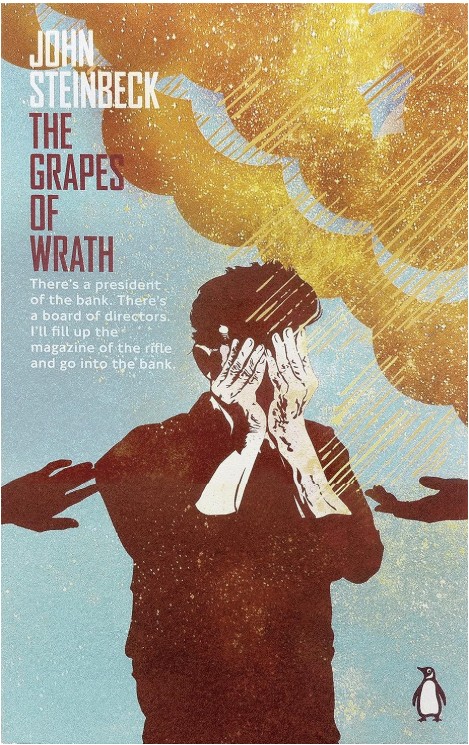
Despite being a prolific reader since I was in late primary school, I have only recently come to read some of Steinbecks work. Namely The Grapes of Wrath and Of Mice and Men (perhaps to be reviewed in later issues). Inspired by a combination of the fact I had not read these classic works, and the fact that Of Mice and Men is part of my son’s year 8 English curriculum.
The book struck a chord with me, similar to the cord struck when I read The Road to Wigan Pier by Orwell. The reader will need to wait to the end to learn why.
Summary
John Steinbeck’s The Grapes of Wrath (1939) has been one of the most forceful American novels of the twentieth century—a fusion of documentary realism, biblical analogue, and political anger. Set in the mid‑1930s during the Dust Bowl[1] and Great Depression[2], it follows the Joad family as they are driven from their Oklahoma tenant farm and forced westward in search of survival.
Notwithstanding a focus on the Joad’s, the book is never just telling their story. Through parallel short stories and anecdotes, or embedded gossip amongst characters it’s a indictment of the hard reality of creative destruction overlaid with economic shock. Combining to crush the vulnerable, but also a testament to the stubborn dignity of ordinary people.
Plot Overview
The novel opens with Tom Joad, newly paroled from prison, returning to find his family’s farm abandoned. Drought, dust storms, and bank foreclosures have pushed thousands of tenant farmers off their land. The Joads, like so many “Okies,”[3] load their lives onto a rickety truck and head for California, lured by handbills promising plentiful work and good wages.
The journey west is both physical and mythic. Steinbeck alternates between the Joads’ personal chapters and broader “intercalary chapters”[4] that zoom out to describe the collective experience of migrants – highway camps, predatory car salesmen, roadside hostility, and the slow erosion of hope. Usually though stories of other groups of people. These chapters give the novel its sweeping generational character, in a book which largely focuses only one the travails of one family. Any reader should be warned, it is without doubt a tale of hardship and suffering, which generally speaking we are past in the western world.
On the road, the Joads suffer losses: the grandparents die en route, the family fractures, and the promised land of California reveals itself as a mirage. Instead of opportunity, they find starvation wages, violent strike‑breaking, and a social order designed to keep migrant labour cheap and powerless. Yet moments of solidarity, like the government‑run Weedpatch Camp, show what humane community could look like.
I won’t detail the ending as I think it worthy of discussion only once the entire novel has been read. It rightly remains one of the most discussed endings in American literature. Steinbeck refuses tidy closure of the story; instead, he leaves the reader with an image of human interdependence as the only antidote to systemic cruelty.
Themes & Analysis
At its core, The Grapes of Wrath is about displacement, exploitation, and the balance between action and moral action. Steinbeck’s narrative would very much seem to suggest that the situation appals him. But he also portrays the migrants not as passive victims but as people whose resilience and decency persist even when institutions fail them.
The novel’s biblical structure—echoes of Exodus, the Sermon on the Mount, and Revelation—elevates the Joads’ struggle within the narrative, to a device that forces one to consider the morals and character traits embedded of the tale. Symbolic characters are prolific in the book. Ma Joad for example is the emotional centre of the book and embodies the theme of endurance: “We’re the people that live,” she insists, refusing despair even as the world collapses around her.
Steinbeck also interrogates capitalism with unusual directness for a mainstream American novel. He depicts banks as faceless “monsters,” agribusiness as a machine that values profit over human life, and the migrants’ suffering as the predictable outcome of an economic system built on inequality. Yet he balances critique with moments of profound human connection—shared meals, roadside kindness, and the fragile hope that people can build something better together. In my opinion there are a number of parallels with “The Road to Wigan Pier”, another contemporary novel, but English.
Style & Impact
Steinbeck’s prose shifts between plainspoken dialogue of the characters and lyrical, incantatory passages. The intercalary chapters, in particular, give the novel its weight, transforming thesimple narrative of individual hardship of the family into a wider story of the suffering and resilience of an entire generation of people. The dual style, combined with a time and place that becomes a magnet for social commentary is, I think the reason it will remain a well-considered fictional novel for a long time.
Verdict
I like it. While I understand its power as a book used for social discussion purposes, and that it will likely stand the test of time for this reason. I am saddened that as time passes people will forget that it was the story of their ancestors the book was representative of.
Robs Context
When I was a young man, I was (and still am) keen on History. Early in high school we studied the Great Depression, and I interviewed my grandmother and Great Uncle. Both of whom had what we now call “lived experience” of that time. From those interviews I had the chance to view that time through the lens of a human who was there. Struggle and poverty became more than an abstract concept to me. At that point I realised that “the great depression” was referred to as great for a real reason.
Grandma used to tell me tales of how hard her father and brothers worked on the farm. How her young brothers would catch rabbits to provide meat, and how she would need to draw water from a well and boil it in the “copper” to wash clothes. Ma Joad of the book provides me echoes of a younger grandmother.
My Great Uncle Ted (Grandpa’s brother) was 18 when his father died at the farm at The Rock in NSW. 1929, you read this article – you know exactly what started then. He was the oldest of the family, and they were unable to stay on the farm and returned to Victoria where the family was split up amongst other family. Again, echoing the book. Surviving the 1930s. He got his first real job in 1939…. shortly after to receive his green envelope for which the Government granted him an all-expense paid 4 year holiday in New Guinea. When Ted died his sister told me that he had never felt the responsibility of the family split leave him. A Bachelor his whole life, looking after my great grandmother until her death he was always the first on in the car to the hospital after the birth of a new member of the family. He is echoed in the book by Tom Joad, the other “main character” to Ma.
The book struck that personal chord with me because of the close parallels to these people. Something most readers are unlikely to find. Which is perhaps a good thing.
[1] The Dust bowl refers not to American Football, but the widespread droughts encountered in the American west and Midwest in the 1930s.
[2] The Great Depression is generally accepted as the worst economic climate of the 20th century where unemployment in the Western World hovered around 30%, and with most currencies being deflationary. While often marked as starting in the 1929 Wall St Crash and finishing around 1933 with intervention. IN reality ion the US and Australia its impact carried through to the start of W2.
[3] Oakies was a derogatory term used by Californians for other Americans migrating into California during the dust bowl and depression.
[4] These chapters are relevant to the overall theme and feel of a book, but do not directly involve the main characters.