Following the Federation of Australia at the start of the 20th Century the various naval forces that the constituent states had previously owned were amalgamated into the Commonwealth Naval Forces, which would subsequently become the Royal Australian Navy. But while the newly created navy tried to sort out what assets it now owned, what was useful and what was just costing money, there was also debate over what kind of force the Navy should be in the future. The two main arguments were for either a relatively small force focussed purely on coastal defence, or a longer-range deep-water force that could secure Australian interests beyond the horizon and act as part of the large Imperial naval forces under Royal Navy command in the event of large scale war.
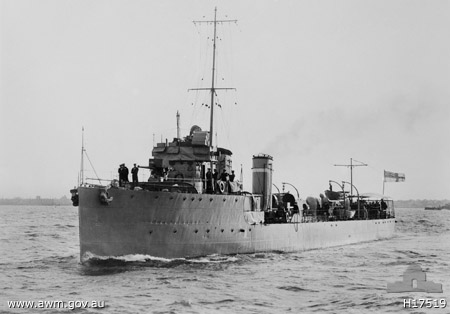
The latter view mostly won out, with a partial ‘fleet unit’ centred on the battlecruiser HMAS Australia ordered at the end of the first decade of the 20th century. While the flagship is well known, it would not be the first vessel ordered and commissioned specifically for the RAN. That honour would instead go to HMAS Yarra (D79).
One of 6 River-class destroyers ordered, and the first to complete from the first batch of 3 (there were small differences between the batches), Yarra built on the mid-1900’s British River-class, but demonstrated a number of significant improvements reflecting the rapid advance of technology at the time. The British ships were a little over 500t displacement and just over 220ft long, with coal powered boilers and vertical-triple-expansion steam engines. Built for short and sharp operations in the North Sea and Mediterranean, they were useful ships for the Royal Navy but the intensive work of shovelling coal was less likely to be viable in the warmer Australian climate and the ships short range would mean such craft would need to refuel 5 times just to go around Australia, with particular concern being expressed that a voyage from Perth to Melbourne might well run them out of fuel short of their destination.
So the design was significantly revised, with the Australian ships becoming longer and wider, with displacement rising to over 700t and the powerplant replaced with oil-fired boilers and turbine engines, significantly less physically intensive to work and between the size and change in fuel the revised design would now comfortably be able to make a voyage from Perth to Sydney without refuelling.
Greater size also meant a chance for more firepower and the British ships armament of a single 3” gun with a few 57mm guns elsewhere plus a pair of single torpedo launchers was upgraded, the 3” gun became a 4” weapon and the 57mm guns were replaced with a trio of single 3” guns, the heaviest gun on the British design thus becoming the lightest gun on the Australian ship. Space was also found to add a third torpedo tube.
The first three ships would be named Yarra, Parramatta and Warrego, with the first two built and completed in the UK and the latter built in the UK then disassembled and rebuilt at Cockatoo Island. Yarra beat Parramatta to commissioning by a narrow margin, thus making her the first Australian warship specifically built for Australia. In order to save space and weight for additional fuel, the ships armament was shipped separately, allowing the two ships to reach Australia with fewer refuelling stops.
With the outbreak of World War 1, Yarra and her two sisters supported the rest of the RAN, first in taking German colonies in the Pacific and then on general patrol and convoy escort duties off the Australian coast and in the greater SW Pacific area.
However, in 1917 the threat of enemy submarines in the European theatre was reaching a critical point and thanks to the development of depth charges ships now had a meaningful way to fight back. The destroyer was held to be the ideal platform and thus the British asked the RAN to send its destroyers to the Mediterranean to help out. Yarra thus spent the rest of the war patrolling the Adriatic, earning a second battle-honour in the conflict.
She did not return home immediately, seeing further action in the Black Sea in anti-Bolshevik operations, then heading to the UK for a refit before she and her sisters finally headed home in 1919. Although modernised at Cockatoo Island the arrived of newer and more powerful destroyers for the fleet meant Yarra and her sisters spent most of the 1920’s in the reserves, occasionally emerging for use as training vessels before being listed for scrapping at the end of the decade. Yarra in particular was stripped for all useful parts and the hull then sunk off Sydney at the start of the 1930’s, with the class as a whole being commemorated with the bow and stern of Parramatta being on display in different locations in Australia today.
Check out Drachinfel Youtube channel here https://www.youtube.com/Drachinifel